Weather has shown some sign of improvement, though it is still not a clear sky. In the morning the wind speed was at 50 knots, not conducive for a chopper flight. Let us see how it turns out tomorrow morning. Waiting like this is very unproductive. No one is doing anything worthwhile. The scientists are having a field day busy in playing cards, game of chess or carom, sipping innumerable cups of tea and coffee. Only people involved in logistics are having a fixed daily schedule. They have to managed generators, boilers, power supply, water supply, heating, sewage, telecommunications, weather monitoring, and cooking every single day throughout the year. And of course, people on galley duty.
Two new wintering members have started sporting a French cut. They might have done for whatever reasons, but I like to think it is their trying to identify with me. There is nothing more flattering than another person trying to imitate you.
Thursday, February 14, 2008

Wednesday, February 13, 2008
Lord Ganesh Around the Universe
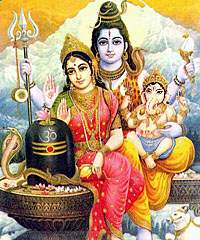
I recently finished reading the book, "Misadventure in a White Desert" by Patrick Woodhead. His team was the youngest and fastest to reach South Pole in 45 days skiing 1100 km in formidable Antarctica interior. On reaching South Pole 90 degrees, he writes, "Just by taking a couple of paces, a person could walk round the world. They would cross every time zone on the planet, traverse every line of longitude. This was the end point, the place where everything converged." That reminded me the story of Lord Ganesha circumambulating the Universe.
We all know Lord Shiva and his consort Parvati have two sons, Karthik and Ganesha. Karthik is agile and powerful, and has a peacock to ride or fly on. Ganesha is obese and comical with a head of an elephant but very intelligent and full of wisdom. During those times too and inspite of being Gods' children they had a sibling rivalry between them. Once they fought over some issue and could not resolve it themselves. They approached their parents for deciding who the winner was. The parents suggested simple solution: to circumambulate the universe! Whosoever completes it first, would be the winner. Karthik, sure of his victory, immediately leaves on his peacock. Ganesha could not match Karthik when it comes to the power game, but he is wise and clever. He puts his both the parents on a spot, circumambulates around them saying that you only are my universe. He is declared the winner. Now, the question is, was Ganesha conversant with the principles of Geography and had he put his parents on the South Pole?
India and the Antarctic Treaty
 The Antarctic Treaty has some very interesting history in its signing in 1959. India's role in the Antarctica is also interesting since 1957 though its expeditions to Antarctica began only in 1981, and it became its voting or consultative member only in 1983.
The Antarctic Treaty was signed on December 1, 1959, and took effect on June 23, 1961.
Twelve nations signed the historic Antarctic Treaty in 1959 soon after the Inernational Geographical Year (IGY): Argentina, Australia, Belgium, Chile, France, Japan, New Zealand, Norway, South Africa, Soviet Union, United Kingdom and United States. Germany and Poland attained voting, or consultative status under the treaty from 1961. India and Brazil became the fifteenth and sixteenth nations with full voting treaty parties in September, 1983.
Twelve nations signed the historic Antarctic Treaty in 1959 soon after the Inernational Geographical Year (IGY): Argentina, Australia, Belgium, Chile, France, Japan, New Zealand, Norway, South Africa, Soviet Union, United Kingdom and United States. Germany and Poland attained voting, or consultative status under the treaty from 1961. India and Brazil became the fifteenth and sixteenth nations with full voting treaty parties in September, 1983.
Antarctica had become a zone of conflicts in 1920s only when many countries began to claim large areas of Antarctica as their own. There were instances of armed conflict. Some stations were also burnt down. I have already told you (Naming of Schirmacher) that Hitler also began its ambition of gobbling up large part of Antarctica in 1938 only but was prevented from entering the fray on any serious note with the start of World War II.
 Diplomats and politicians of claimant countries began negotiations soon after the WW II to come to some agreement in exploiting the potentials of Antarctica. However, an amicable agreement eluded them till Soviet Union managed to successfully launch its Sputnik, the first orbiting artificial satellite on 4th October, 1957. Sputnik demonstrated to the astonished Allies that the Soviets had the capability to send rockets over intercontinental distances. Besides its impact on Western defense strategy and foreign policy, Sputnik made Southern Hemisphere allies nervous that the Soviets may also exploit desert like conditions of Antarctica for nuclear purposes. Suddenly, their internecine disputes in Antarctica were dwarfed by the common fear of a Soviet military presence there. A formal accord among nations, including the Soviet Union, renouncing military activities there seemed the only way to forestall a costly arms race.
In 1956, and again in 1958, India had suggested that the United Nations take up Antarctica. Indian PM Jawaharlal Lal Nehru had initially proposed, and then dropped, his suggestion that the UN take up the Antarctic question. The claimant states successfully dissuaded India from pursuing the move further.
In September, 1983, the twelfth consultative meeting in Canberra, Australia opened with participation of its 14 consultative members. These 14 parties admitted two more-India and Brazil. These two countries did not share the original treaty nations' historic interests in Antarctica. However, both were considered large and politically influential developing nations which had sent recent expeditions to Antarctica indicating enough scientific interest in the region to meet the requirements of Article IX, the treaty's test for full membership.
In 1981, the government of Indira Gandhi decided to send an expedition to Antarctica, hinting that India also might join the treaty. Although at the time it was not even an acceding party, India's 1981 Antarctic expedition was the first sent by any nation entirely outside of the treaty framework. India leased a Norwegian icebreaker, the Polar Circle, and assembled a team of scientists led by the Department of Ocean Development. They trained in the high altitude of Himalayas known for bad weather. The Polar circle, with a predominantly Indian crew, sailed from Goa to December 6, 1981 and reached the Antarctic coast on January 9, 1982. There the team constructed a weather station, carried out radiation and magnetic surveys, and planed the Indian flag. It called the base Dakshin Gangotri. The following season a second Indian expedition returned to Antarctica, where it collected enough data to enable the setting up of a permanent manned station in its third expedition in 1983.
If the Gandhi government had clear motives, they were not apparent to the outside world. India national pride was apparent in the statement that "the Indian success at the very first attempt is therefore recognized the world over as a remarkable achievement."
The Gandhi government was deliberately ambiguous towards both the treaty group and the developing world. It scored points, however, with the treaty powers by stating that the expedition was "purely scientific", that India had no territorial ambitions in Antarctica, and that India subscribed to the principles of the treaty. But before the expedition left, the Indian government notified other developing nations of its plan-in effect, testing the waters of developing world opinion. Consultative status in the treaty-and an accompanying scientific presence in the region-may offer great prestige value to developing nations.
India's actions, therefore, may foreshadow the future in Antarctica more than all the law papers combined. In 1981, India was the only major nation looking south across the ocean toward Antarctica that had no historic presence there. Nehru tried to introduce the subject of Antarctica in the United Nations at the time treaty was being negotiated. His remarks at the time suggest that he was more concerned with keeping the peace than with elaboration of Third World rights over Antarctica's mineral and oil potential. India's expeditions to Antarctica indicate the government is capable of major scientific undertakings. Its Antarctic programme may be but the latest step in India's efforts to secure recognition as a serious technological power: it has launched its own satellites, detonated nuclear devices, and it has expanded its oceanographic and offshore petroleum explorations.
(Reference: The Seventh Planet: Antarctica in a Resource Age (1985). Deborah Shipley; Resource for the Future Inc; Washington D.C.)
Sunday, February 10, 2008
A 'Nail Biting' Farewell
I am not lucky even the fourth time. Today I was to have my maiden flight in chopper for going to the ship. The wind speed is not less than 50 knot judging by the jerks my hut is receiving. Weather is worse around the ship. So may be another couple of days here; Maitri ka daana-paani khatam nahin hua hai. Some of the younger lot of the team are quite resentful in not being able to go over the ship. "Why weren't we sent when weather was so clear and we had finished our work here?" they ask indignantly. I am angry on myself. I did not take bath or wash my clothes for last two days leaving it for the ship. I should not have done it believing in Murphy's law. In keeping with this law, may be I shall be able to go tomorrow as I shall bathe today as well as wash some clothes. But it is Antarctica, you never know. One major problem with the delayed departure, if it happens, would be less time for people from Survey of India who were to do detailed study of the topography of Larsemann Hill.
For last three days, there is farewell every evening in small groups on private basis. I am surprised that there was no formal farewell for the ten members of the 26th IAE either by the remaining members or by the 27th team when every now and then cultural evenings are organized. My farewell speech is wasted.
I had told you that I had organized a farewell party for myself with the members of the logistic team of the 27th IAE. I get along with them quite well and we all are members of the Dooda Beta Film Club. We squeezed ourselves in the loft of Annapurna lounge where four members have their beds. My own hut would have been quite inadequate with no extra chair or floor space. I have enough now to go with any evening party, gifted to me by the members who have already left. Why did I think of this get together? Well, I have imbibed it from Chitra. Secondly, there was wine still lying untouched since I bought it in Goa in November before flying in here. I did not know what to do with it. Bringing it back to Goa would be anticlimax. Five of the eleven assembled have done one winter here earlier. They regaled us with some of the stories of their expeditions. For example, Raghunathan had to confine himself in a tiny hut on the ice shelf for three days when blizzard hit unannounced. His worry was not how to survive since where ever IAE has huts, they are equipped with food all the year around. He struggled about his nature calls. He could not venture out as along with the blizzard there was white out too, and in those conditions if you get lost outside you are doomed. Arjun too was holed up in a hut with his colleague during his last expedition for ten days when blizzard hit them. It was a hut with scientific instruments in a little remote area with no toilet facilities inside. Arjun stopped eating or ate very little to save him the ignominy of shitting inside the hut where he conducted his scientific work. His colleague was shameless in this respect. When they were rescued ten days later, Arjun was emaciated and barely able to speak coherently or walk on his own feet. However, what all these men remembered most or still remember are the people with whom they spent their long winters here. They have managed contacts not with all but at least with some of them till date.
For last three days, there is farewell every evening in small groups on private basis. I am surprised that there was no formal farewell for the ten members of the 26th IAE either by the remaining members or by the 27th team when every now and then cultural evenings are organized. My farewell speech is wasted.
I had told you that I had organized a farewell party for myself with the members of the logistic team of the 27th IAE. I get along with them quite well and we all are members of the Dooda Beta Film Club. We squeezed ourselves in the loft of Annapurna lounge where four members have their beds. My own hut would have been quite inadequate with no extra chair or floor space. I have enough now to go with any evening party, gifted to me by the members who have already left. Why did I think of this get together? Well, I have imbibed it from Chitra. Secondly, there was wine still lying untouched since I bought it in Goa in November before flying in here. I did not know what to do with it. Bringing it back to Goa would be anticlimax. Five of the eleven assembled have done one winter here earlier. They regaled us with some of the stories of their expeditions. For example, Raghunathan had to confine himself in a tiny hut on the ice shelf for three days when blizzard hit unannounced. His worry was not how to survive since where ever IAE has huts, they are equipped with food all the year around. He struggled about his nature calls. He could not venture out as along with the blizzard there was white out too, and in those conditions if you get lost outside you are doomed. Arjun too was holed up in a hut with his colleague during his last expedition for ten days when blizzard hit them. It was a hut with scientific instruments in a little remote area with no toilet facilities inside. Arjun stopped eating or ate very little to save him the ignominy of shitting inside the hut where he conducted his scientific work. His colleague was shameless in this respect. When they were rescued ten days later, Arjun was emaciated and barely able to speak coherently or walk on his own feet. However, what all these men remembered most or still remember are the people with whom they spent their long winters here. They have managed contacts not with all but at least with some of them till date.
Saturday, February 9, 2008
The Unsung Spouses: The 'Real' Expeditioners
I talked to the members of the 26th IAE individually to know how they prepared themselves, physically, mentally or otherwise, before coming here in November, 2006. I was very keen to know how they prepared their families to weather their absence from home for next 15 months. How did they convince their wives to let them go and not see them for another 15 months? Chitra, please, do not read in between the lines.
I got very interesting answers, so different from my own imagination or expectations.
Most the members I talked to are from the logistic team which is the backbone of the expedition. They are from the Indian Army or the Border Roads Organization serving as technical staff. They are usually posted in difficult remote areas and their families are used to their absence extending for up to 6 months at a stretch. However, expedition to Antarctica was a different ballgame.
The objections of the families were at two levels: family management and personal safety of the expeditioners. Most of them have children who are in the crucial stages of their education. These children are now preparing to enter university. The families are very keen that their children should get good education, since that is the only way for upward mobility. Mothers felt that father's presence was necessary at such a crucial juncture. It is another thing that at such crucial stages, it is the mother who handles situation more logically and rationally. Fathers are always a hindrance. I can vouch for it from my own experience. During my deputation (1997-1999) to the B.P. Koirala Institute for Health Sciences, Dharan (Nepal), Kushagra was working hard to seek admission in a US university and Vasuman was preparing to enter the University for studying Law. It was entirely to Chitra's credit that both of them managed to enter into professions of their choice.
Wives were also worried about the safety of their husbands in the extremely harsh climate and working conditions of Antarctica. Some men in their wisdom advised their families to watch Discovery or National Geographic channels on telly to get some familiarity with the region and appreciate its beauty. However, the unending ice, deep crevasses, severe blizzards had the opposite effect. The petitions were summarily rejected in most cases. The men had to play their trump card then. "It is once in a life time opportunity; it will help in my career; I shall get a choice posting for three years on my return, etc. Men also cited financial remunerations as additional benefit out of this expedition.
"How do they find their wives at this juncture when they are about to end their expedition?" This question elicited most interesting responses. They discovered a new side of their wives. They found that given the challenge or responsibility, they not only rose to the occasion, but also met the challenge satisfactorily and admirably. This is when most of the wives have received only limited education. Thus they could handle the children and their education and their growing demands, manage the family affairs as well as intricacies of extended families. One member was totally surprised on discovering that his wife had managed to convince the Principal of a school for granting admission to her children. One wife managed to get an early allotment of a house for the family from the Army station. Most of them managed to handle affairs such as banking, insurance, payment of bills etc which they had not attended to in their lives.
I could see clearly the sense of pride in men's voice and faces when enumerating the instances where wives managed to accomplish tasks where they themselves would have run into difficulty. They had seen a new side of their wives that would have eluded them if they had not come to the Antarctic expedition. They acknowledged the fact that in managing all these affairs and problems for more than one year, the wives had totally ignored their own exhaustion, boredom, loneliness, empty beds, and worries while they themselves remained busy and excited about their new experiences in Antarctica.
One member put it very succinctly, "I had many new things to look forward to in Antarctica and had the support of an entire nation; however, she back home managed an expedition totally on her own."
I got very interesting answers, so different from my own imagination or expectations.
Most the members I talked to are from the logistic team which is the backbone of the expedition. They are from the Indian Army or the Border Roads Organization serving as technical staff. They are usually posted in difficult remote areas and their families are used to their absence extending for up to 6 months at a stretch. However, expedition to Antarctica was a different ballgame.
The objections of the families were at two levels: family management and personal safety of the expeditioners. Most of them have children who are in the crucial stages of their education. These children are now preparing to enter university. The families are very keen that their children should get good education, since that is the only way for upward mobility. Mothers felt that father's presence was necessary at such a crucial juncture. It is another thing that at such crucial stages, it is the mother who handles situation more logically and rationally. Fathers are always a hindrance. I can vouch for it from my own experience. During my deputation (1997-1999) to the B.P. Koirala Institute for Health Sciences, Dharan (Nepal), Kushagra was working hard to seek admission in a US university and Vasuman was preparing to enter the University for studying Law. It was entirely to Chitra's credit that both of them managed to enter into professions of their choice.
Wives were also worried about the safety of their husbands in the extremely harsh climate and working conditions of Antarctica. Some men in their wisdom advised their families to watch Discovery or National Geographic channels on telly to get some familiarity with the region and appreciate its beauty. However, the unending ice, deep crevasses, severe blizzards had the opposite effect. The petitions were summarily rejected in most cases. The men had to play their trump card then. "It is once in a life time opportunity; it will help in my career; I shall get a choice posting for three years on my return, etc. Men also cited financial remunerations as additional benefit out of this expedition.
"How do they find their wives at this juncture when they are about to end their expedition?" This question elicited most interesting responses. They discovered a new side of their wives. They found that given the challenge or responsibility, they not only rose to the occasion, but also met the challenge satisfactorily and admirably. This is when most of the wives have received only limited education. Thus they could handle the children and their education and their growing demands, manage the family affairs as well as intricacies of extended families. One member was totally surprised on discovering that his wife had managed to convince the Principal of a school for granting admission to her children. One wife managed to get an early allotment of a house for the family from the Army station. Most of them managed to handle affairs such as banking, insurance, payment of bills etc which they had not attended to in their lives.
I could see clearly the sense of pride in men's voice and faces when enumerating the instances where wives managed to accomplish tasks where they themselves would have run into difficulty. They had seen a new side of their wives that would have eluded them if they had not come to the Antarctic expedition. They acknowledged the fact that in managing all these affairs and problems for more than one year, the wives had totally ignored their own exhaustion, boredom, loneliness, empty beds, and worries while they themselves remained busy and excited about their new experiences in Antarctica.
One member put it very succinctly, "I had many new things to look forward to in Antarctica and had the support of an entire nation; however, she back home managed an expedition totally on her own."
Friday, February 8, 2008
Of Subhash and Venu - Two Of My Mates
Subhash is a mason from the Border Road Organization and has been to all difficult terrain and areas of Indian border, for example, J & K, Leh, Siachen, and North Eastern states of India. He is a resident of a small town, Rewari (Haryana) about 50 km from Delhi, on Jaipur Road. Many times he entertains us with interesting stories and anecdotes from his posting to different areas. In Annapurna hut, he would always insist to make tea for me reassuring me that he would put less sugar. He is also a regular member at the Dooda Beta Film Club. While coming back when both of us were talking together ahead of others, I asked him about his family back home. He was willing to talk and I was a patient listener. He comes from a family with modest means. As the only son of his father he inherited only one acre of land and a dilapidated family house. He worked hard and saved hard. He gave good education to his two daughters. The elder one is graduate (B.A.) and is married. And having a graduate daughter in the state of Haryana (where girls are becoming fewer and fewer), he would not settle for any useless brat. So his son in law is M.A. (English), B.Ed and working as teacher. His youngest daughter will be entering university this year. In between the two daughters, he has a son aged 22. Understandably, as the only son he has not done well academically. However, he has managed to get employed at a mobike factory. Soon after reaching India, Subhash will get him married to a girl already selected by the family. He is not worried about the marriage of his youngest daughter. He draws comfort from the fact that she will attract far too many proposals. Subhash has added to his immovable property. He bought another acre of land and has more than doubled the floor area of his house on a bigger plot of land. He did not conceal his pride in telling me that with limited means and education, meager inheritance and a lowly paid job, how he has improved his stature in his clan and society. I marveled at his hard work and planning for his family as well as his financial management. I almost felt ashamed.
Venu is a wintering member of our Team. He is part of the logistic team in capacity of vehicle mechanic. He has wintered here earlier. He is just 42 and has obtained retirement from the Indian Army after completing 20 years. I find very strange; there are many retired technicians from Army this time in the 27th IAE for wintering. They all are in their forties and have retired. Venu is a good natured man and we get along famously. He is always smiling, but is very funny usually in the evening for obvious reasons. Of course, he is fond of his Rum and then his reaction time gets shorter and shorter in cracking one liners. Though he is from Kerala, the 'God's own country', his knowledge about Hindi movies is as good as mine. So when we both are in the summer lounge watching a movie together, we both are cracking jokes or comments. He is fond of dancing and dances well during cultural programme when booze is on the house. He always drags me on such evenings to the dancing floor, not that I mind. On the Republic Day, he came to me to drag me and I just declined for no particular reason. He immediately got angry and disowned me announcing, "This doctor is no friend of mine; if I ever get crazy here, do not let him treat me".
Venu is a wintering member of our Team. He is part of the logistic team in capacity of vehicle mechanic. He has wintered here earlier. He is just 42 and has obtained retirement from the Indian Army after completing 20 years. I find very strange; there are many retired technicians from Army this time in the 27th IAE for wintering. They all are in their forties and have retired. Venu is a good natured man and we get along famously. He is always smiling, but is very funny usually in the evening for obvious reasons. Of course, he is fond of his Rum and then his reaction time gets shorter and shorter in cracking one liners. Though he is from Kerala, the 'God's own country', his knowledge about Hindi movies is as good as mine. So when we both are in the summer lounge watching a movie together, we both are cracking jokes or comments. He is fond of dancing and dances well during cultural programme when booze is on the house. He always drags me on such evenings to the dancing floor, not that I mind. On the Republic Day, he came to me to drag me and I just declined for no particular reason. He immediately got angry and disowned me announcing, "This doctor is no friend of mine; if I ever get crazy here, do not let him treat me".
Wednesday, February 6, 2008
Chandigarh to Delhi - Commute of 'Antarctic' Proportions
I may have taken 18 hours in air to reach Antarctica traveling more than 12,000 km. But can you believe this that Chitra (my wife) took the same amount of time on roads only two days ago to travel from Chandigarh to Delhi, a distance of only 250 km with finest of the roads! We may not tire ourselves in shouting at the top of our voice that India is the largest democracy in the world, but when it comes to settling grievances we adopt most undemocratic means. To lodge their protests, some people descended on the highway and blocked the traffic forgetting the miseries of the commuters. And as luck would have it, Chitra, who was otherwise booked to travel in the evening by a fast train, decided to return by a luxury coach when she finished her work at Chandigarh in the morning itself. When she was less than 100 km away from Delhi, the block was thrust upon the usually heavy traffic between Chandigarh and Delhi. She was caught in between - to wait and move forward when embargo lifts up or return to Chandigarh. Ultimately, she decided to return to Chandigarh only after a futile wait of many hours inside the coach. She returned next day only, 24 hours later of which she spent 18 hours on the road.
Subscribe to:
Posts (Atom)
REVERSE PSYCHOLOGY
REVERSE PSYCHOLOGY Recently on my visit to Chawri Bazaar in old and real Delhi, where my ancestors settled, lived and thrived ever si...

-
 REVERSE PSYCHOLOGY Recently on my visit to Chawri Bazaar in old and real Delhi, where my ancestors settled, lived and thrived ever si...
 -
 I heard of Roopkund in 2002, when, after having returned from the US, I wanted to accompany Vasu for some trekking trip in Himalayas. Since ...
 -
 I Love Kashmir More and More… Some time back when Prof Mohd Ashraf Ganie contacted me over phone to be a speaker for this conference...