I first came to know of Sardar Fauza Singh in June of 2004 while I had just begun my job in the National Health Services as consultant in Leicester, England in 2004, while watching a BBC programme. I wrote the following piece then to share with my friends. I thought to share it with the web community now.
WHAT IS COMMON BETWEEN MR GEORGE CHAMBERS AND SARDAR FAUZA SINGH
June 2004
What is common between Mr George Chambers and Sardar Fauza Singh, well, both are nonagenarians.
As you are probably aware, I have been appointed as Consultant in Adult Psychiatry at the NHS. That effectively means that I should normally be seeing people between the ages of 16-65 years, though, sometimes I may continue to see a patient beyond 65 too if he/she were receiving care from our services earlier also, and the reasons of consultations have not changed. I have enjoyed looking after elderly people at AIIMS, New Delhi. They have many interesting stories to tell and enrich you with their vast experiences. And they come with less complicated personal problems. Looking after them would have been ideal here, as adult psychiatry at general hospital setting is much different here as compared to India. You are saddled with so much personality disorder patients, and you keep on struggling with their unchanging life styles, and recurrent problems at all the fronts, personal, social, relationships, and repeated suicidal attempts and drug and alcohol problems. And if it is anti-social personality, then it is icing on the cake. Most of the times they are unemployed, but are well looked after by the government-provided monetary benefits.
A few days ago, I was on emergency call duty. I was assured by my other colleagues and friends that there was nothing to worry about this since as a consultant, one hardly gets a call to see the patients in emergency. Mostly, junior doctors are able to handle it, or may take your advice on the phone. Well, true to Murphy’s law, call came in the afternoon from the Surgery ward of this hospital asking me to see a 92-year old patient who was threatening to commit suicide. I wondered why this call came to me, should have gone to the Old-age Psychiatric Unit. I did not know where to protest, so I went. I went to the surgical ward, and found Mr Chambers sitting on a chair chatting with his friend. He appeared to be not more than 70-75, had full growth of white hair, erect spine, and shook hands with a firm grip, and greeted me with a smile and clear loud voice. He had survived surgeries for prostate cancer, colon cancer and a few others. Lately he had had a few fainting episodes which resulted into his current admission, and that was worrying him. Surgery team had not taken this into account while drafting after-discharge care plan. He had lost his wife a few years ago, and was leaving alone in his bungalow with part-time support from the social worker. His concern was that if he fainted at home, and no medical help was available on time, he would die unattended. It was a reasonable concern. So when surgery team asked him casually in the morning if he was looking forward to going home, he replied he would shoot himself after reaching home. Then the surgery team decided to send for a psychiatrist. I found him a very reasonable person, full in command and well articulate. I assured him that I would recommend his case for him to shift to an old age home with all the facilities. When I was about to leave, he asked me if I was from India, and on my affirmative reply, he told me that he spent 4 years in India during the WW II. I had stood up to leave, but I sat down again. And he narrated some of his experiences while living in Lutyen’s Delhi. His memory was sharp, and he could remember the ‘Viceroy’s Palace, Queens way and Kings way, Jahanpanabad, Tughalak Fort, ChandniChowk, Delhi summer with mosquitoes and malaria, and of course delicious mangoes. His journeyes to Shimla, Dehradun, Massourie, etc etc. Lastly he said that the biggest mistake British did was to segregate India into two. I had come to see him quite reluctantly, but I left very satisfied.
Sardar Fauza Singh is a 93-year old gentleman living in England for last 50 years. He too served in Royal Army. I saw him only on the BBC, being interviewed before his participation in the London marathon. Participating in marathons is his way of life. Has gone all over the world for such meets. His bone scanning was done some time earlier, the age of his right leg came to be 35 years, and that of left 50 years.
Sunday, October 23, 2011

Tuesday, October 18, 2011
CENTENARIAN Fauza Singh does it once again : with a marathan
(Pictures and text from the Toronto Star)


TORONTO—Fauja Singh secured a spot in the Guinness Book of World Records on Sunday at the Scotiabank Toronto Waterfront Marathon. The 100-year-old accomplished an amazing feat, becoming the oldest person ever to complete a full-distance 42-kilometre marathon. It took Singh over eight hours to cross the finish line — more than six hours after Kenya’s Kenneth Mungara won the event for the fourth straight year — and he was the last competitor to complete the course. But his time wasn’t nearly remarkable as the accomplishment itself. “Beating his original prediction, he’s overjoyed,” said coach and translator Harmander Singh. “Earlier, just before we came around the (final) corner, he said, ‘Achieving this will be like getting married again.’ “He’s absolutely overjoyed, he’s achieved his life-long wish.” Although event workers dismantled the barricades along the finish line and took down sponsor banners even as Singh made his way up the final few hundred metres of the race, a throng of media, family, friends and supporters were there when Singh made marathon history. And Singh, who only speaks Punjabi, also surprised himself. Through his interpreter, he said he had set a goal of finishing the race in about nine hours. “He said he achieved this through the help of God but even God must be getting fed up of helping him,” Harmander Singh said, drawing chuckles from assembled media after the race. Sunday’s run was Fauja Singh’s eighth marathon — he ran his first at the tender age of 89 — and wasn’t the first time he set a record. In the 2003 Toronto event, he set the mark in the 90-plus category, finishing the race in five hours 40 minutes and one second. And on Thursday in Toronto, Singh — whose first name means soldier — broke world records for runners older than 100 in eight different distances ranging from 100 metres to 5,000 metres. Singh, a five-foot-eight, 115-pound British citizen and vegetarian, looked tired and spent following the race and organizers gingerly assisted him to the post-event news conference. After receiving gentle massages to his legs and calf muscles as well as cups of water from members of his entourage, Singh leaned back on a couch and spoke little to start the news conference. But a short time into it, he began looking remarkably relaxed and fresh with his hands clasped behind his head. Then, he abruptly sat up straight and with a smile, motioned for the microphone, obviously getting his second wind.
“He says he’s recovered now so he’s going to talk,” his translator said, again drawing laughter.
Affectionately dubbed the Turbaned Tornado, Singh began running roughly 20 years ago after losing his wife and child. The five-foot-eight centenarian said he’s happy to see more minorities taking part in such marathon events and is hopeful his next project will be participating in the torch relay for the 2012 London Summer Games.
Singh carried the torch during the relay for the 2004 Athens Games.
Race director Alan Brookes struggled to find the right words to describe Singh’s remarkable accomplishment. “I’m speechless,” he said. “Fauja Singh is a remarkable human being.”
A 100-year-old man began Thursday with a sprint and ended with eight world records.
Fauja Singh ran through eight track events in succession at Birchmount Stadium in Scarborough as part of a charity event, Sikhs in the City.
Running — and smashing records — gave Singh some focus following the death of his wife and son. He became suicidal after watching a piece of sheet metal decapitate his son. Then he moved to England to be near his other son.
And then he just felt like running and setting records.
“I am but a simple man,” Singh the competitor, a Sikh with a long white beard who only speaks Punjabi, said in a translated statement. “I give it my best shot and it happens that the results are better than others.”
He’s already set three records for men over 90 — one for 10,000 metres, which he completed in 64 minutes in the Lahore Marathon in 2005; and two in Toronto, for a half-marathon in 2004 (2 hours 29 minutes 59 seconds) and a full marathon in 2003 (5 hours 40 minutes 1 second).
“I always wanted to be the oldest marathon runner and said to myself that if an opportunity presented itself, I will not turn it down,” said Singh.
He chose Toronto because it is where he had his best showings before. Plus, the people “seem more accommodating of other cultures than some other parts of the world where the Sikh appearance is wrongly prejudged.”
Singh wants to raise money for local charities, including Guru Gobind Singh Children’s Foundation, which is run by children and youth to help other kids meet basic needs.
But still. 100.
“In the Punjabi language, there is no such word as impossible,” said Singh the trainer.
At an age where having a healthy mind is itself a feat of strength, Singh the competitor is in remarkable — borderline miraculous — physical shape.
His trainer points to a bone density test done last year when the runner was 99. Singh’s left leg was found to have a density of a 35-year-old; his right leg had that of a 25-year-old.
Times to beat
Wednesday, March 2, 2011
INDIAN ARMY EXPEDITION SKIIS ALL THE WAY TO SOUTH POLE

Double click on the image to have a larger view.
Wednesday, January 12, 2011
INDIAN EXPEDITION TO SOUTH POLE

(photo courtesy: Ashit Swain)
 (Group photo and text from The Hindu dt 12/11/2010)
Cooking was toughest: Indian South Pole expedition team
The Hindu Rasik Ravindra, Director, National Centre for Antarctic and Ocean Research (third left) along with team members of the first Indian Scientific Expedition. Photo: Shiv Kumar Pushpakar
It was not the bone-chilling minus 54 degrees Celsius, the difficult terrain or even the cold gusts blowing at 150 km/hour, but lighting a stove and cooking that posed the biggest challenge to the eight-member team of India’s maiden expedition to the South Pole.
The team led by National Centre for Antarctic and Ocean Research director Rasik Ravindra traversed the shortest path to reach the southernmost tip in just eight days.
Speaking about his experiences during the expedition, Mr. Ravindra said: “The toughest challenge was to cook, as in temperatures as low as minus 50 degrees Celsius it was difficult to light the stove.”
“We were carrying ready-to-eat meals with us but we had to put them in boiling water for cooking, and boiling water in this temperature was tough,” the 62-year-old Ravindra said.
The team said there were some depressing moments during the expedition but their determination and team spirit carried them through successfully.
“When we started, we were worried about the low temperature, high altitude and shortage of oxygen at that altitude. Many times our vehicles developed some problems, we faced a lot of problem melting ice into water and cooking,” said Pradip Malhotra, expedition doctor.
The team, consisting of a geologist, glaciologist, geophysicist and a meteorologist as well as vehicle engineers, had left Maitri, India’s second permanent research station on the Antarctica, on Nov 13.
“It was a gratifying experience and a lifetime opportunity. Once you reach there, you will realise the importance of basic things like fire, water and warmth. Despite making so much advancement in technology, you still have to depend on nature so much,” said M. Javed Beg, in-charge of logistics during the expedition.
The expedition travelled on four specialised Arctic trucks and each of these vehicles, besides its human baggage, carried special gears, emergency medical kit, frozen food, and navigational and scientific instruments.
The scientists conducted five experiments during the journey.
Wednesday, October 6, 2010
Thursday, September 30, 2010
TREK TO VALLEY OF FLOWERS AND HEMKUND SAHIB

When I told my family and friends that I wanted to trek to Valley of Flowers and Hemkund Sahib this August, everyone thought I was just crazy. Besides Delhi, the rain gods had been relentless over Uttarakhand too causing road breaches at multiple sites in various hill towns. There were landslides everywhere and traffic to all the well known pilgrimage centres of Badri Nath, Kedar Nath, Gangotri and Yamunotri were getting cut off from rest of the country every now and then. The group I was trying to assemble had fallen through. But to do justice to the Valley of Flowers, one has to trek there in the month of August only when the entire valley is at its best bloom. So finally, I enquired at the Garhwal Mandal Vikas Nigam Ltd (www.gmvnl.com) if they had any vacancy for its weekly tour to Valley of Flowers – Hemkund Sahib – Badri Nath. Of course, they did not have any for the month of August. However, I was banking on some cancellations hoping some people might not like to venture on this trek in view of not a very comfortable situation of roads etc. I checked practically everyday with gmvn’s offices in Rishikesh, Dehradun and Delhi to enquire about the status of roads. Finally my luck struck gold; there were indeed some cancellations and Rishikesh office booked me and Rajesh for the group leaving from Rishikesh on the 25th August, and assured me that GMVN would look after our safety with utmost care.
Valley of flowers was another trek that I heard first from Motor Mama (see my post on Pindari trek for more on him). He had done it in 1970s, and had talked very often about it.
Day 1: we left Delhi in afternoon by Jan Shatabdi Express going to Dehradun, and got off at Haridwar, and took a bus to Rishikesh. From bus stand, the gmvn’s rest house, Bharat Bhumi, was not too far and there were many auto-rickshaws waiting to take us there.
Day 2: After a light breakfast we left Rishikesh by bus for our night halt at Joshimath, which normally one should cover in about 10 hours. But the sky was already overcast and one could not anticipate when a landslide or roadblock would greet us. Our group of 25 mostly had people above 50. Half of the group was of people above 65 years of age. It was nice to see old people venturing out for some adventure. Just two hours later, we hit our first of the roadblocks due to landslide. Mercifully, the staff of BRO (Border Roads Organization) was already at work with a bulldozer when it was still drizzling. It is to the credit of BRO that the roads in Himalayas remain travel worthy inspite of inclement weather; due to better communication facilities, the help arrives on time with efficient equipment. We passed through Devprayag which has confluence of Alaknanda (coming down from Badri Nath) and Bhagirathi (coming down from Gaumukh and Gangotri). These two sacred rivers join to form the mighty Ganga river; so it is from Devprayag only that river is called Ganga.
We also passed through Rudraprayag which has confluence of Alaknanda with Mandakini coming from Kedar Nath.

By evening we reached our third prayag of the day, Karanprayag which has confluence of Alaknanda with Pindar river, coming from Pindari glacier. The great warrior Karna of Mahabharat fame was supposed to have worshipped Sun god here to get the impregnable shield.
All the rivers which we saw were swollen with huge flow of water. By this time we had hit a number of roadblocks, but were fortunate not to have been delayed for too long. We reached Joshimath at about 9 pm and were lodged in the gmvn guest house in the main bazaar. It was poorly maintained and bed linen was damp and dirty. We made noise but could not do much.
3Day: We left Joshimath (I was happy leaving this guest house) early in the morning soon after our cup of tea to reach Govind Ghat from where we were to start our trek to Gangharia. It looked like a small town developed on both side of a narrow road on either side of which there were shops selling religious artifacts with equal number of small eating houses. Govind Ghat, as the name suggests, is surrounded on all sides by hills; it has a Gurudwara which has plenty of accommodation for pilgrims on their way to Shri Hemkund Sahib. We did not stay here for long, and as soon as we could hire a porter to carry our bags, we started on our trek. There were too many porters and far too many ponywallahs. Since tourists were less than expected this time owing to news of incessant rains splashed over all print and electronic media, we were pestered all the way by these pony-owners. Traditionally, all the pony-owners are local Garhwalis, while porters come from Nepal. These porters are reliable and sturdier.

The landscape was quite scenic with hills all around and river Bhyundar gushing down noisily hitting boulders all along its course. Because of cloud cover, we could not see snow clad peaks.

There were far too many eating places with ubiquitous paranthas, maggi, packaged snacks. There were shops for fresh fruit juice as well as for dry fruits too. The ponies had killed the joy of a leisurely trek; one had to make room for them to pass by, the entire stretch was littered with their solid waste; mercifully, the rains were washing it away too, but at many places it had created slush making that stretch stink. I reached Gangharia after 6 hrs of trek covering 14 km, and had come to an altitude of 3048 m (10,000 ft). To cater to the ever increasing number of pilgrims to Hemkund Sahib and trekkers to the Valley of Flowers, this ‘once upon a time a tiny high altitude village’ has developed into a noisy, thriving market place with dhabas and guest houses everywhere. There is a gurdwara, Gobind Dham, which gives to shelter to pilgrims on their way to Hemkund Sahib; langar and hot tea is available throughout the day. Since no traveler is allowed to stay overnight at either Valley of Flowers or Hemkund Sahib, everyone has to stay here in transit. Gangharia does not have a resident population; the whole area comes to life during 4-month period when visitors start pouring in during June to September.
Day 4: We were to trek to the Valley of Flowers, 3352–3658 m (11060-12070 ft). Its entry is ticketed and, mercifully, not open to ponies. We trekked 4 km uphill through a forest to reach an open expanse of valley. One could trek for another 3 km. From the beginning of forest, flowers of all colour and hue were scattered here and there – what a beautiful treat.


The birch trees were in abundance; at this height that is one of the trees that thrives. The beauty of Valley of Flowers can only be appreciated by visiting it. It is said that nearly 80 varieties of flowers are found here. There are many kinds of birds, and this area is home to brown bear, black bear, snow leopard, and blue sheep (bharel). Since inside the forest and valley area, no eating places are allowed, we had carried packed lunch for ourselves. It was a bright sunny day, and having aloo-paratha in the Sun, surrounded by flowering shrubs in the backdrop of Gauri parbat was heavenly. The whole area is much sought after by botanists, photographers and nature lovers. Some of the well known flowers are Brahm-kamal, blue poppy, cobra lily, anemones, geranium, delphinium, bell flowers, etc. The rhododendron flowering season was already over in August.
Day 5: I woke up early in the morning with some trepidation. We were to trek uphill for 7 km and attain an altitude of 4329 m (nearly 14,500 ft; some estimate its height to be more than 15,000 ft). It was overcast and had started drizzling. No high altitude peaks were visible. We started our upward journey with loud cries of ‘jo bole so nihaal, Sat Sri Akal’. The trek to the Gurudwara is steep all the way, with no flat section. I managed 4 km not with much difficulty; there were pilgrims of all ages; a few young couple were walking carrying their tiny tots in their arms. After 4 km, progress became a bit difficult, I had to stop after every few steps to catch my breath. People coming down would encourage by saying it was not too far any longer; offerings of biscuits, candy, and even glucose, and constant chant of ‘Wahe Guru’ kept me going. When the shrine was just one km away, some outer structure became visible. I got a fresh lease of life; how easily I covered that last kilometer, I could not have imagined a little while ago. I was just in time for the ‘Ardas’ beginning at 12 noon. I decided to have dip at the holy sarovar; the water was icy cold, but I did not waste time, I just went in and quickly immersed myself in the water, and before my head could become numb, I was out in a jiffy. I could persuade Rajesh and another fellow traveler to do the same. After having had dips in some high altitude lakes, including Manasarovar, I had figured out that the key to having a dip here was speed: just go in, immerse yourself completely and immediately and come out, before the body gets a chance to be affected by extremely low temperatures; don’t wait for body to get acclimatized, since it won’t ever. After Ardas, I went around; there is a ‘Lakshman temple also here, it needs maintenance and renovation. Around the glacier lake, ‘Brahm-kamal’ was flowering in abundance. The lake is supposed to be surrounded by 7 Himalayan peaks, but none was visible due to cloud cover.
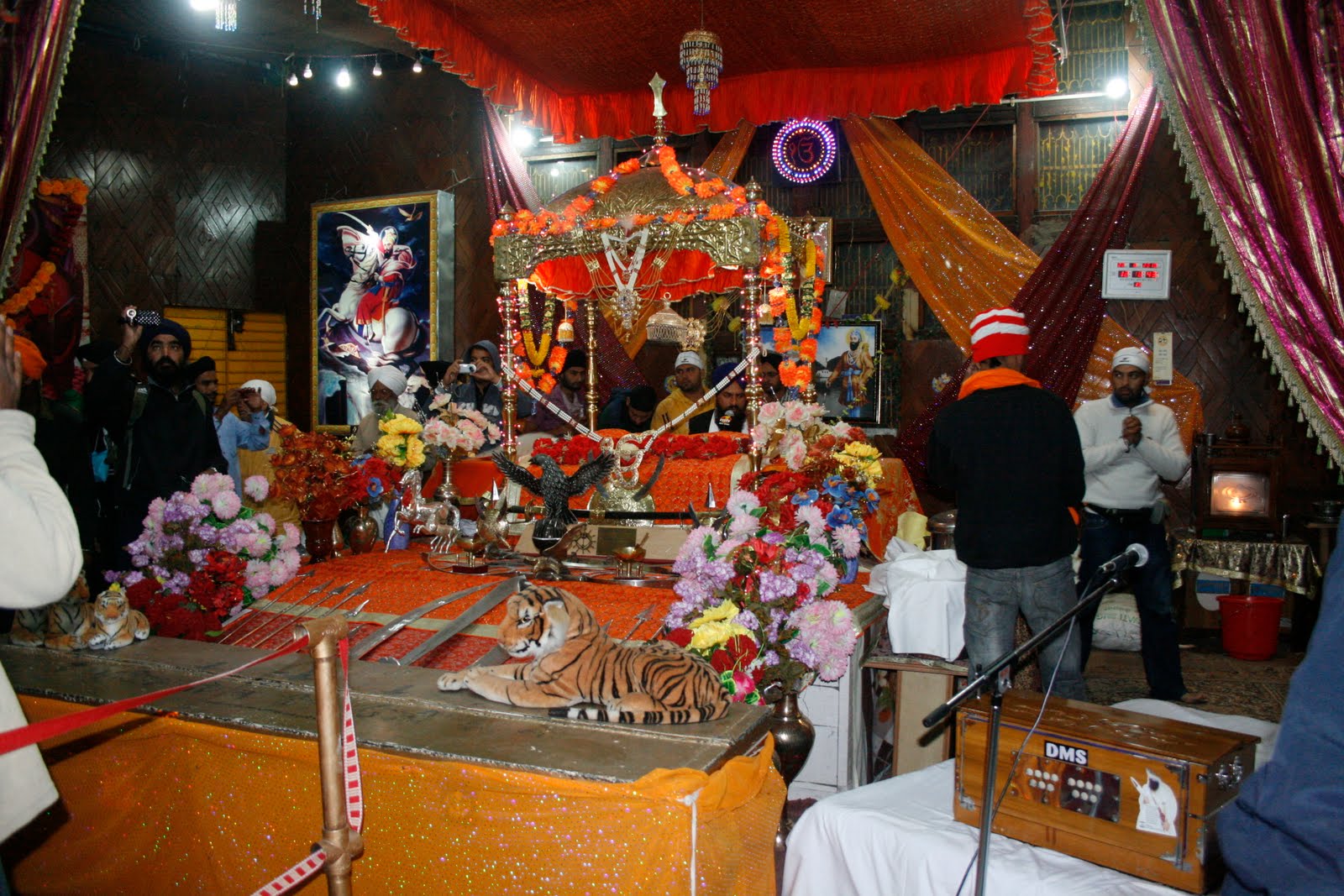

The Hemkund Sahib Gurudwara is the highest Gurudwara in the world. Its history makes an interesting read and is available in many books and websites. Its location was rediscovered only in 1932, and the structure was built subsequently.
Day 6: We started our march downhill. It had been raining since early morning. The progress was slow, however, midway the rain stopped and bright sunshine was most welcome. Bus was waiting for us to take us to Badri Nath shrine where we were to spend one night. The GMVN guest house at Badri Nath was a welcome change after our stay in dirty lodging at Gangharia. We came across two more confluences, Nandprayag (Alaknanda joined by Nandakini coming from Nanda Devi, and Vishnuprayag (Alaknanda joined by Dhauli Ganga coming from Niti pass). At Badri Nath, besides having a darshan at the shrine, we went to the last Indian village, Mana, on this side of Himalaya. It was all very nostalgic, since I had spent some very good time here in 2007 for my induction training for Antarctica expedition.
Day 7: We turned back towards Delhi now, and stayed at Peepal Koti.
Day 8: We reached Rishikesh on time, and left by bus for Hardwar from where we were to board our train for Delhi.

Inspite of all the torrential rains, landslides at multiple sites, and many road blocks, we managed this trek well on time and without any hazard. Gods had been very kind. It is a common knowledge that the Himalayas, 20 million years old, is still the youngest mountain; is still growing, and is geologically active. Since it consists of sedimentary and metamorphic rocks, it is porous and very light and prone to landslides. In the Indian Himalayas, the situation has been made worse by indiscriminate deforestation. I have been to Himalayas many times, but never saw how ‘kachcha’ these mountains are. This season, the upper layer of the mountains has just been washed away, and what you see is just loose rocks, boulders, and soil. It was quite scary, more than the swollen rivers or landslides. If we do not do something seriously with honesty and sincerity, we shall stand doomed.
Subscribe to:
Posts (Atom)
REVERSE PSYCHOLOGY
REVERSE PSYCHOLOGY Recently on my visit to Chawri Bazaar in old and real Delhi, where my ancestors settled, lived and thrived ever si...

-
 REVERSE PSYCHOLOGY Recently on my visit to Chawri Bazaar in old and real Delhi, where my ancestors settled, lived and thrived ever si...
-
 I heard of Roopkund in 2002, when, after having returned from the US, I wanted to accompany Vasu for some trekking trip in Himalayas. Since ...
-
 I Love Kashmir More and More… Some time back when Prof Mohd Ashraf Ganie contacted me over phone to be a speaker for this conference...